In Development

Powered by Heraklion

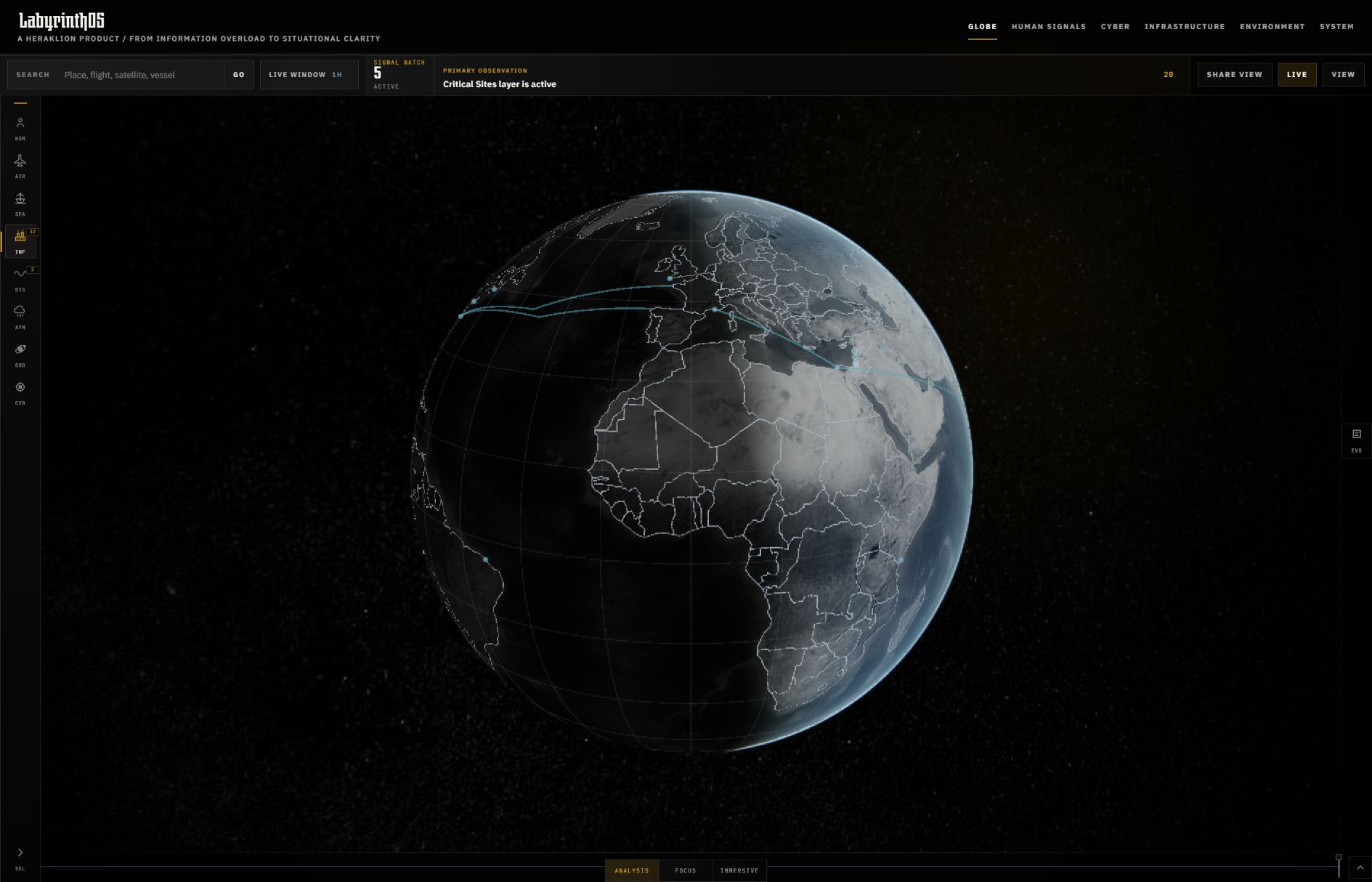
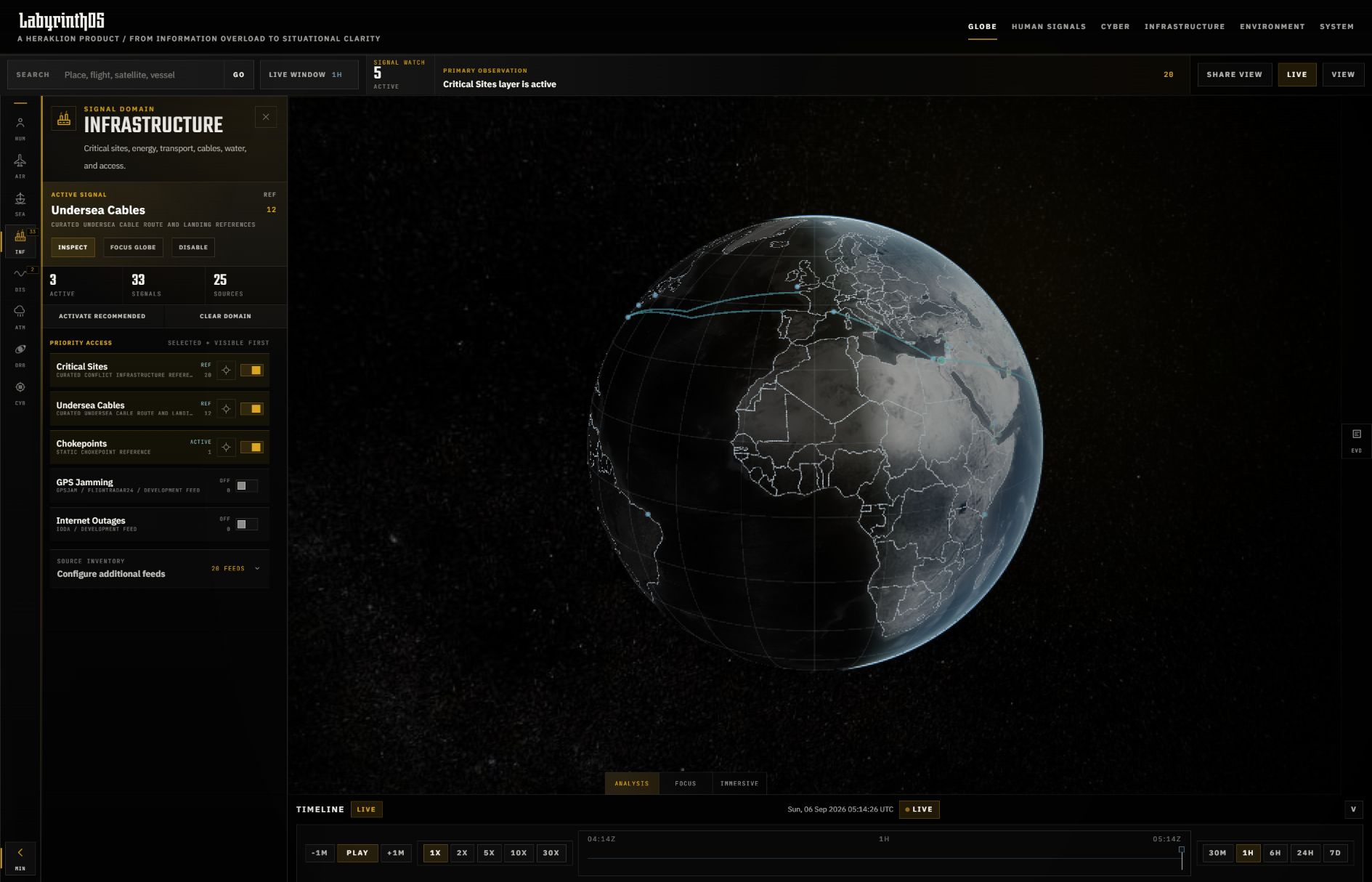
Real-time data fusion platform rendering dozens of live feeds — weather, disasters, aviation, maritime, conflict, space, and infrastructure — onto an interactive 3D globe with unified timeline playback. Built for analysts and newsrooms.

Weather & Atmospheric Natural Disasters Civil Aviation Military Aviation Maritime / AIS Conflict & OSINT GPS Jamming Internet Outages Orbital Tracking Solar & Aurora Submarine Cables Power Grid Critical Sites
Next.js CesiumJS TypeScript Zustand PostgreSQL
Inside the platform

Live build, in progress

Historical hurricane storm path tracing
Live traffic cam feeds
Oceanic currents
Oceanic currents
Oceanic currents
Oceanic currents
Aircraft traffic
Aircraft traffic
Orbital tracks
Orbital tracks
Orbital tracks tracing
Correlation engine
Correlation engine
Correlation engine observations
The Mission

Operators stitch together a dozen dashboards to make sense of a single event

A journalist or analyst tracking an unfolding event today has to flip between ADS-B Exchange for aircraft, AISStream for ships, NOAA for weather, USGS for earthquakes, GDELT for news discovery, and a dozen RSS feeds for human reporting — then somehow correlate them in their head.

That stitching is where confirmation bias creeps in. It’s also where speed dies: by the time the separate dashboards agree, the story has already moved.

LabyrinthOS is the unified evidence workbench they don’t have today. Globe-first, signals-first, sources-attributed. Built for journalists, newsroom editors, disaster analysts, and OSINT researchers who need to validate what they’re seeing in seconds, not hours.

The platform surfaces observable signals, not opinions. Users should be able to see events directly rather than being guided toward a predetermined interpretation. — LabyrinthOS guiding principles
How It Works

Six rungs of corroboration on a single globe

Every signal that lands on the globe carries a position on a corroboration ladder. Human reporting starts as context, not conclusion. Stronger evidence elevates it.

  1. Reported. Initial discovery from GDELT or a single media source. Treated as a lead, not a fact.
  2. Cross-source. Multiple independent human-signal sources (Reuters, BBC, Bellingcat, Al Jazeera, NHK, OCCRP) agree on the basics.
  3. Structured. ACLED, ReliefWeb, or equivalent normalizes the report into a verifiable, geocoded event.
  4. Operational. NOTAMs, aircraft diversions, AIS rerouting, GPS jamming, or internet outage signals corroborate physically.
  5. Physical. Sensor-derived data — NASA FIRMS hotspots, USGS earthquakes, NOAA radar — confirms what’s on the ground.
  6. Official. Government or UN releases (DoD, FCDO, UN News, White House) elevate the bundle to record.
The Heart

A correlation engine that’s queryable, versioned, and honest

Most correlation systems are black-box similarity scores. LabyrinthOS’ correlation engine is the opposite — every situation bundle is a structured object with named evidence roles and an explainable score.

When the engine seeds a wildfire, it sweeps a configurable radius and time window for nearby events. Each finding gets classified by role — seed, physical, operational, human report, infrastructure context, environment context, or digital disruption — and the resulting bundle exposes confidence as a clamped 0–1 score with a plain-text explanation.

Current situation types: wildfire emergency context, volcanic aviation hazard, conflict signal cluster, coastal tsunami context. Rules are versioned (tempest-correlation-v0.1), so an analyst can audit which logic produced any historical bundle — and so the rules themselves can evolve without breaking the past record.

Bundles surface as candidates, not conclusions. The engine doesn’t auto-elevate them. It surfaces suspicious clusters for analyst review — which is exactly the discipline serious intelligence work requires.

Under the Hood

113 routes, 30+ live feeds, sub-minute ingest

113
API routes
30+
Live data feeds
25+
Background ingest jobs
10
Signal domains

Next.js 16, React 19, and CesiumJS on the front. PostgreSQL + TimescaleDB + PostGIS (Neon hosted) on the back. Cloudflare R2 for snapshot archives and replayable field frames.

The signal_events table is a TimescaleDB hypertable optimized for append-heavy ingest. A separate signal_observations table preserves the history for time-travel playback. A reserved events table holds interpreted intelligence that isn’t raw ingest. Clean separation of concerns — raw ingest, current-state reads, replay history, interpreted output — means the system stays auditable as it grows.

A standalone Node worker runs 25+ recurring jobs, from 1-minute NOAA weather alert sweeps to 2-hour ocean current refreshes. Every job posts persistence-status headers back through the ingest routes so the background worker can distinguish source failures from database failures — a piece of observability discipline most platforms never bother with.

Per-source content rights enforcement is baked into the schema. RSS feeds are metadata-only by default; government-allowlisted feeds get full-text retention; everything else stops at the headline. There’s no “oops, we scraped a paywall” failure mode.

Atmospheric & Weather
NOAA alerts, NEXRAD reflectivity, GFS wind grids, NDBC buoys, DART tsunami buoys, ocean currents via NOAA CoastWatch ERDDAP.
Aviation
ADS-B Exchange (sharded by region), OpenSky Network, ADS-B.fi for military, NOTAMs, ADIZ zones, airport reference layer.
Maritime
Live AIS via AISStream WebSocket, vessel tracking, undersea cable infrastructure, landing-station context.
Disaster
NASA FIRMS hotspot detection, NIFC fire incidents, NASA OpenVEDA fire perimeters, USGS earthquakes, river gauges, tsunamis, rogue waves.
Space
CelesTrak TLE-based orbital tracks, NASA DONKI space weather, NOAA SWPC aurora and Kp index, solar flares, meteor showers.
Infrastructure & Connectivity
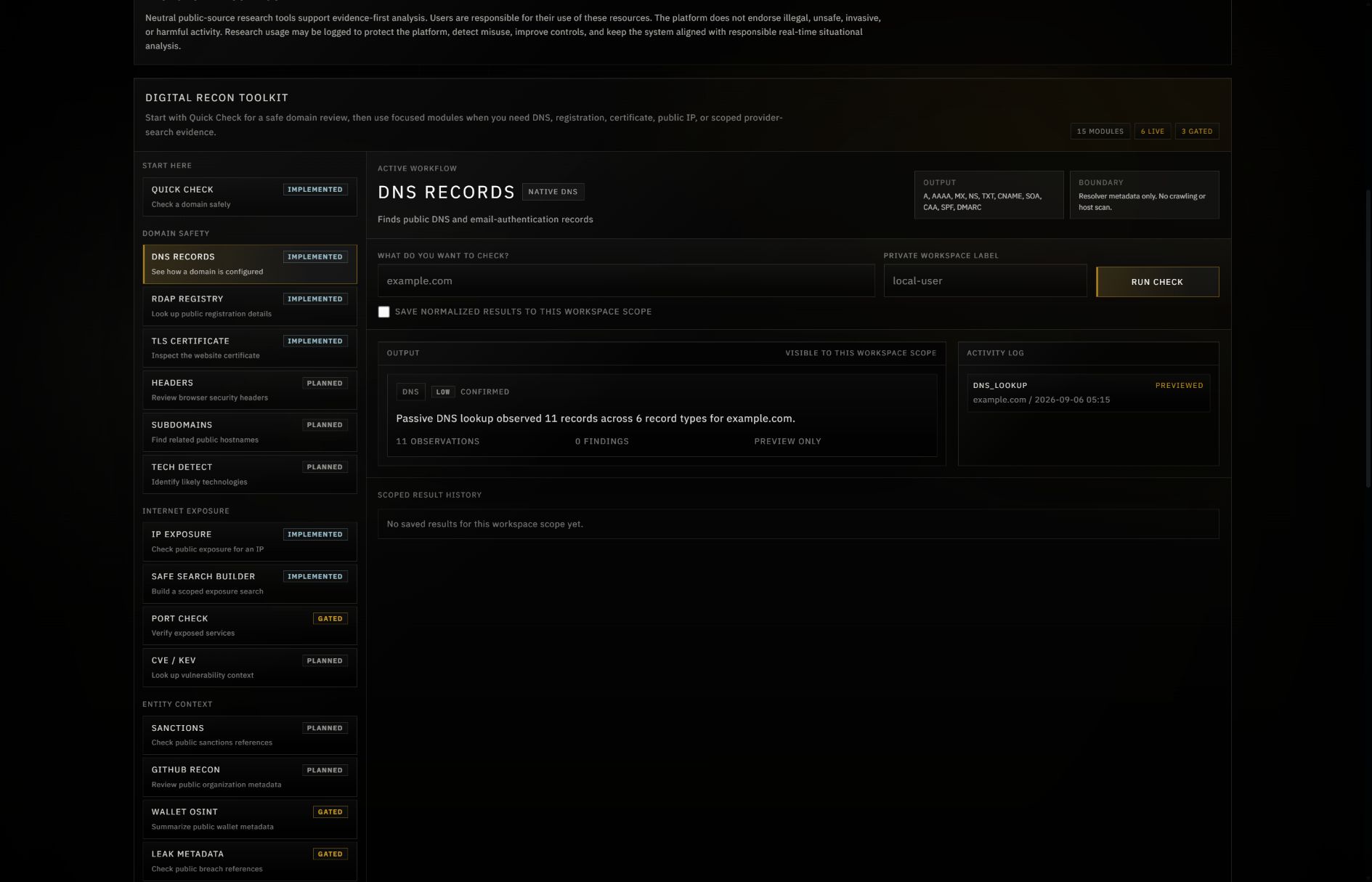
OSM-derived military and diplomatic sites, GPSJam hotspots, IODA internet outage detection, traffic cameras from Caltrans / TfL / GDOT / WSDOT / 511.
Human Signals
GDELT global event discovery, RSS from Reuters, BBC, Guardian, Bellingcat, Al Jazeera, NHK, FT, OCCRP. Structured conflict data from ACLED. Official releases from DoD, FCDO, UN.
Reference & Context
Geonames place search, OSM landmarks, World Bank water and exposure data, ADIZ zones, borders, conflict-zone polygons.
Principles

Signals over narratives

The technical decisions follow from a small set of product principles that are written down, lived in code, and visible to the user.

Signals over narratives. The platform surfaces observable signals, not opinions. Users see events directly rather than being guided toward a predetermined interpretation.

Evidence before interpretation. Interpretation requires sufficient corroboration. The platform exposes the evidence trail behind every bundle so the analyst — not the system — gets the last word.

Transparency of data sources. Every signal carries provenance metadata: trust tier, access mode, fetch and update timestamps, normalizer version. The source-catalog API exposes layer health, cadence, and auth requirements so the user always knows what they’re looking at.

Honest about grounded vs. estimated. The orbital tracks layer separates what’s grounded (TLE-propagated satellite position, sub-satellite point) from what’s estimated (observation footprint, sensor coverage). Most platforms collapse that distinction; LabyrinthOS preserves it. That framing pattern shows up across the system.

Build Pattern

Two developers, one product, no crosstalk

LabyrinthOS is co-developed 50/50 with Brandon Shirley. We divided feature lanes by domain, both ship code, and we use branch-specific isolated worktrees to keep async remote work from stepping on each other.

27 architecture decision documents in /docs/architecture/ make the rationale behind every layer reviewable — geolocated news markers, orbital tracks, ocean currents, conflict intelligence workflow, the GDELT integration plan, the data-flow contract. Each design choice is recorded with the constraints that drove it, not just the outcome.

The same discipline applies to AI collaborators: AGENTS.md and AGENT_RULES.md codify how external agents are expected to behave inside the repo — worktree boundaries, data isolation, commit conventions.

Product strategy, architecture decisions, and the operating guidelines are joint work. Implementation is split by feature lane — whoever owns the lane ships it end-to-end, with code review across the boundary.

What This Enables

Evidence-grounded reporting at the pace of an unfolding event

Newsroom-grade event validation in seconds. Toggle between “breaking story” (GDELT, RSS) and “physical corroboration” (aircraft diversions, fire hotspots, GPS jamming, internet outage) in a single panel. The same workflow that takes a reporter forty-five minutes across seven tabs takes ten seconds in LabyrinthOS.

Conflict intelligence standardization. The corroboration ladder isn’t just an internal pattern — it’s a teachable framework that lifts analyst maturity wherever the platform goes. Operators trained on LabyrinthOS learn to question the difference between “reported” and “structured” evidence whether they’re inside the platform or not.

Infrastructure resilience analysis. Undersea cables, power plants, military sites, conflict zones, and weather all in one view enables vulnerability forecasting and impact modeling that requires seven specialized tools in any other workflow.

Evidence persistence. Replayable orbital tracks, atmospheric field snapshots, and historical signal observations let analysts answer questions ephemeral dashboards can’t: what was overhead when this happened? where was the wind blowing? which aircraft diverted within the hour? Forensic analysis becomes a first-class capability, not a manual reconstruction job.

Status: LabyrinthOS is pre-MVP and in active development. The capabilities described here are built and running — not aspirational. Target users, pilot deployments, and go-to-market specifics are still being shaped; case-study updates will follow as those become concrete.