Bring AI into the creative process.
My focus is building how AI-assisted graphics fit into Mosaic’s creative workflow, from an initial direction to material that can be reviewed and refined.
Brandon and I conceived Mosaic together. He began the implementation, and I’m building its realtime AI graphics workflow—helping shape the product as well as developing a specific part of it.

Mosaic began as an idea Brandon and I developed together. Brandon took the first steps in execution and started implementing the product.
My role spans that shared product concept and the realtime AI graphics workflow I’m now building within it. The case study reflects both contributions: our joint role in conceiving Mosaic, and our distinct work in bringing it to life.
Mosaic is its own product, separate from LabyrinthOS.
My focus is building how AI-assisted graphics fit into Mosaic’s creative workflow, from an initial direction to material that can be reviewed and refined.
The workflow needs room to evaluate a result, make changes, and decide what belongs in the composition. That is part of the product experience I’m working toward.
The aim is to make AI useful within the wider graphics workflow, with a clear path between creating material and using it in a scene.
I used my existing Colts Blue Zone package as a benchmark for AI-assisted graphics production. The experiment rebuilt a segment opener as an editable Blender scene, then explored a refreshed treatment using the same production process.
I directed the look and revisions; AI authored the scene-building code, including typography, geometry, materials, lighting, and animation. The two silent clips below show the reconstruction and refreshed treatment.
“Keys to the Game”: layered silver lettering, blue fabric, and animated accents. A 10-second recreation study based on the existing package.
A second 10-second study explores depth, lighting, and layout while retaining editable scene elements. An exploratory treatment.
These are standalone production studies informing my Mosaic workflow development. The clips were rendered in Blender; they are not recordings of Mosaic’s interface or proof of a completed engine integration.
Solar Court explores a dimensional broadcast world: golden forms, concrete architecture, and warm reflected sunlight. Heat Check takes an illustrated direction, with oversized type, painted textures, and independently moving subjects.
The selected images use the latest saved revision of each study: Solar Court v09 and Heat Check v05. They document concept development and visual refinement as the wider realtime workflow takes shape.

Basketball grain, restrained gloss, and the bevel and wear of the golden emblem.

A title-free review frame exposes the panel construction, sunlight, and court surfaces.
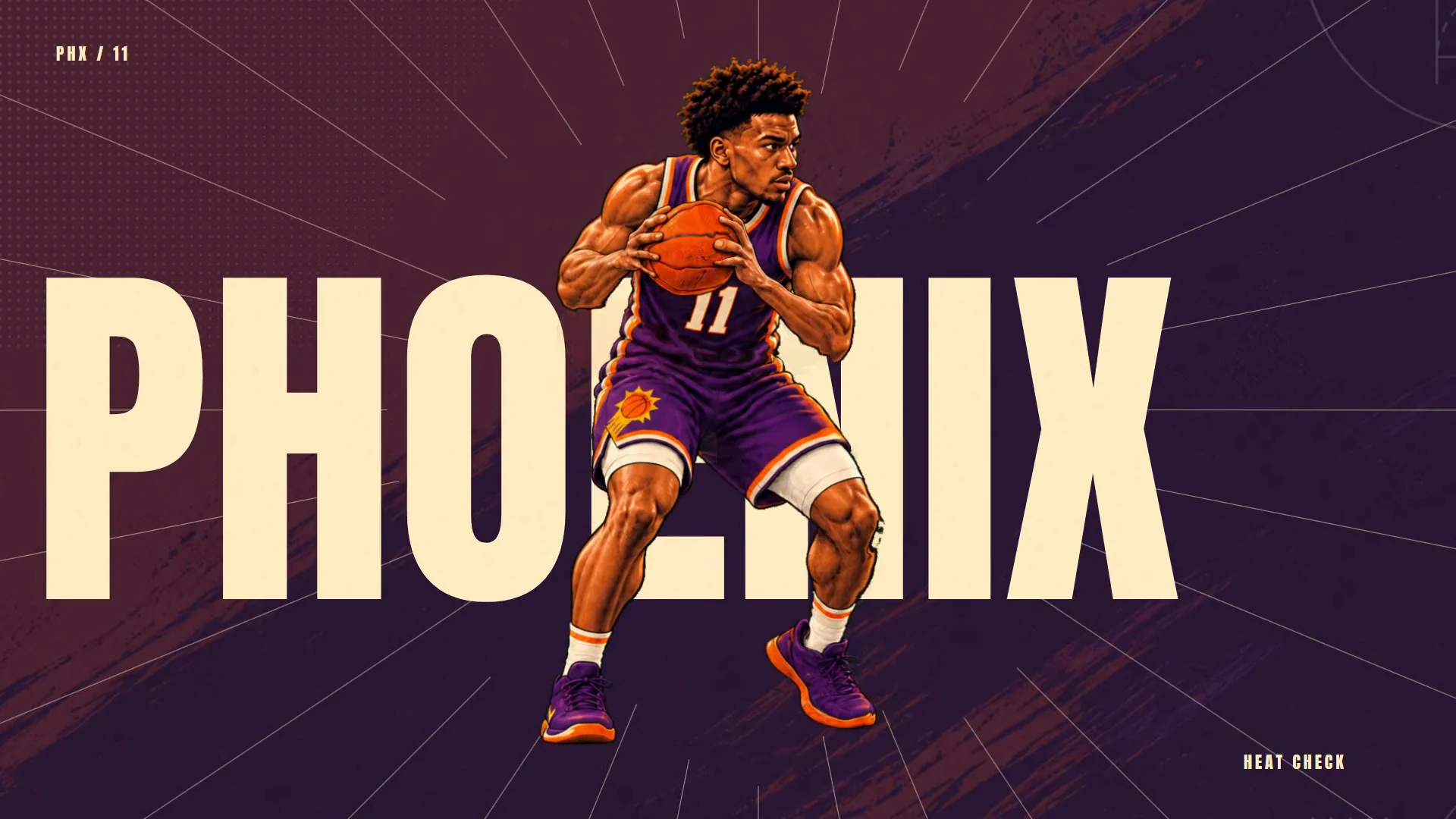
A frame from the latest motion proof, exploring player gesture and ball contact.

Separate typography, illustration, and texture layers support a more flexible motion workflow.
Independent Phoenix Suns concept work. The selected frames are development studies, not an official team commission or a finished broadcast package. Solar Court v09 is a still-review revision; Heat Check v05 is a motion proof with further animation refinement ahead.
This work connects two parts of my practice: helping define what a product should do, and developing the workflow that makes an idea useful to the person using it.
Mosaic is collaborative work in development. The AI graphics workflow described here is my current area of work; it is not presented as a completed production deployment.
Credits: Product concept—Nick and Brandon. Initial implementation—Brandon. Realtime AI graphics workflow—Nick.