DSICustom decision models for business.
Decision Super Intelligence is a business model we created for custom-trained decision models and their application to business workflows. The offer combines forward-deployed implementation, training around a company’s own decision criteria, and ongoing operation and improvement.
01 / The business opportunity
Build around the decisions a business makes every day.
Businesses repeatedly route requests, assess opportunities, review documents, and prioritize work. Those decisions depend on company-specific standards and the judgment of experienced people. DSI proposes models trained around that context, with human review feeding a measured improvement process.
We developed the business model around both the technology and its delivery: which decisions to address, how to establish a useful workflow, what a client pays for, and how the service continues to create value after implementation.
02 / A service built around the model
Implementation, specialized training, and ongoing operation.
Start with the client’s workflow.
The proposed engagement begins with forward-deployed engineering. Work with the client to define a decision, connect the agreed tools, establish a base-model workflow, and review early results against the business’s standards.
Approved feedback becomes training material for a specialized model. Separate evaluation cases support comparisons between versions, while ongoing monitoring identifies where further training or a change in workflow could help.
- 01 / Implement
Define the decision, connect the agreed systems, and establish the initial workflow.
- 02 / Review
Assess cases against the client’s criteria and collect approved corrections.
- 03 / Train
Use permitted examples to specialize a model, then compare it on separate evaluation cases.
- 04 / Operate
Monitor results, support the workflow, and scope further training when the evidence supports it.
Proposed delivery model for the service. Customer-specific training and production serving are in development.
03 / Applications across the business
Different workflows. Business-specific criteria.
Potential applications include routing customer-support requests, prioritizing sales opportunities, triaging operational work, and reviewing content. Each starts with a defined decision, the context needed to make it, and an agreed way to assess the result.
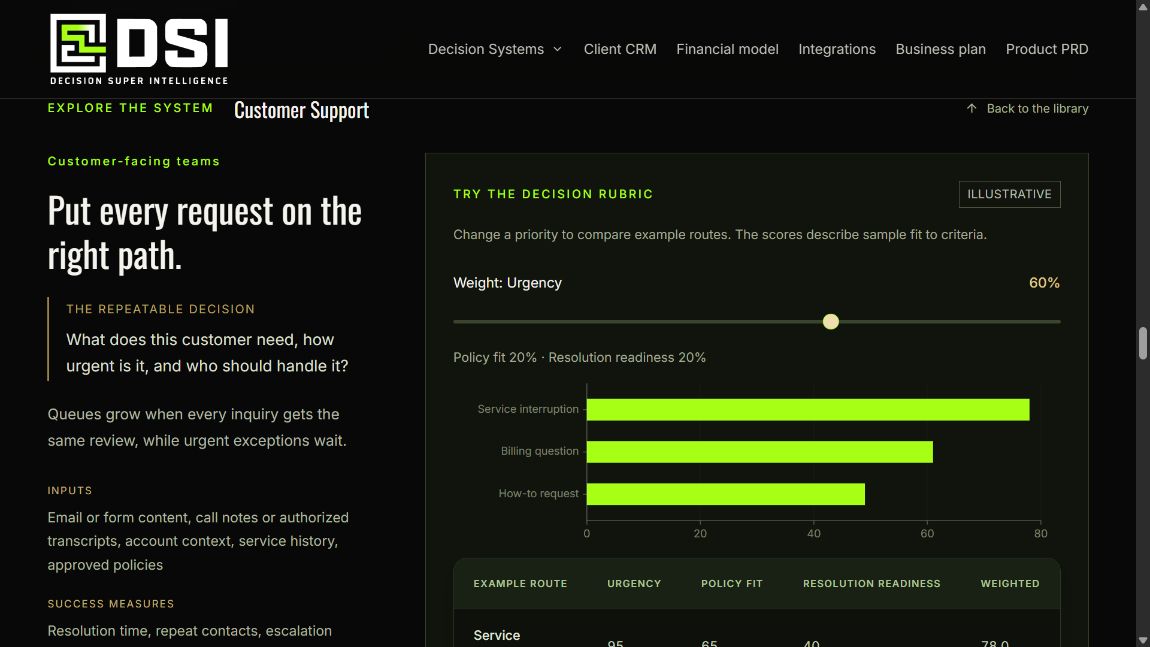
For customer support, a model could assess urgency and route a request to the right team using the company’s policies and reviewed examples. The business planning work connects each application to a delivery scope, integration needs, operating costs, and a customer value case.
04 / The commercial model
Price the implementation and the ongoing work.
The commercial model combines an initial implementation engagement with recurring model hosting, usage, monitoring, and support. Training rounds have their own scope and cost. Custom application adapters, email workflows, and browser extensions are separately scoped development and maintenance services.
Our work includes application definitions, service packaging, pricing assumptions, delivery economics, integration plans, and platform requirements. The intended ongoing value comes from models, evaluations, and workflows tailored to each client. Customer-specific training, automated retraining, and production model serving remain planned capabilities.
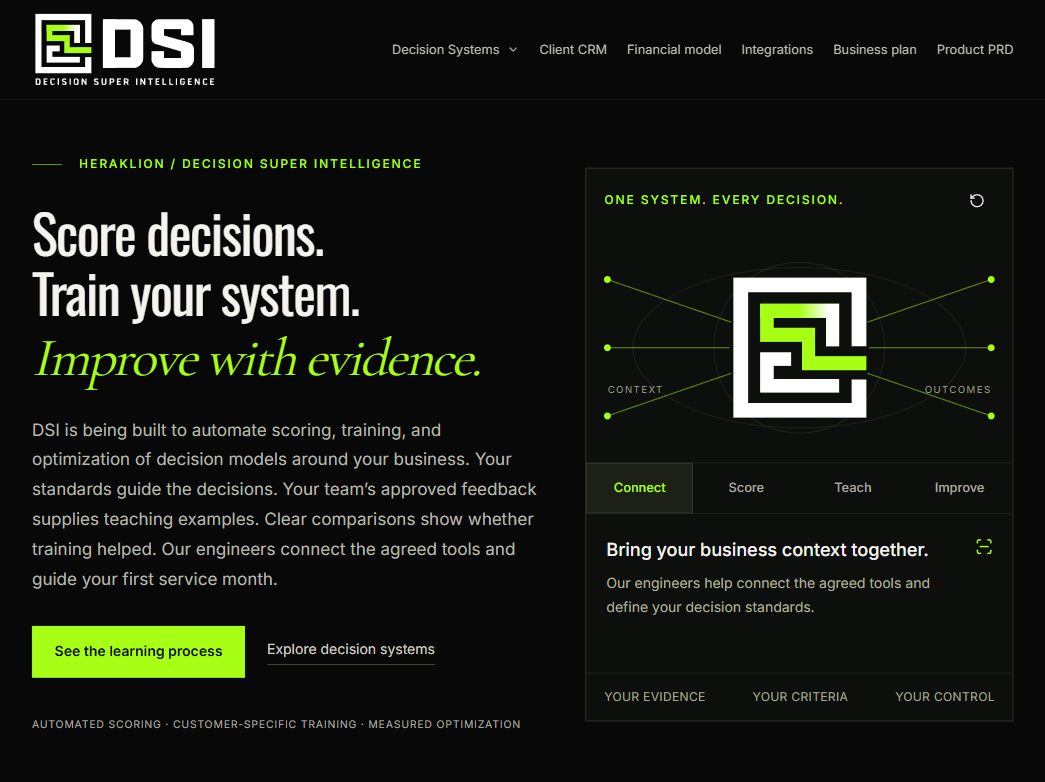
Identity assets from the DSI project. Screenshots captured from its existing local build in October 2026, using public planning content and an illustrative support example. No client records or private proposals are shown.
A venture in planning
Decision models, forward-deployed.
Continue exploring